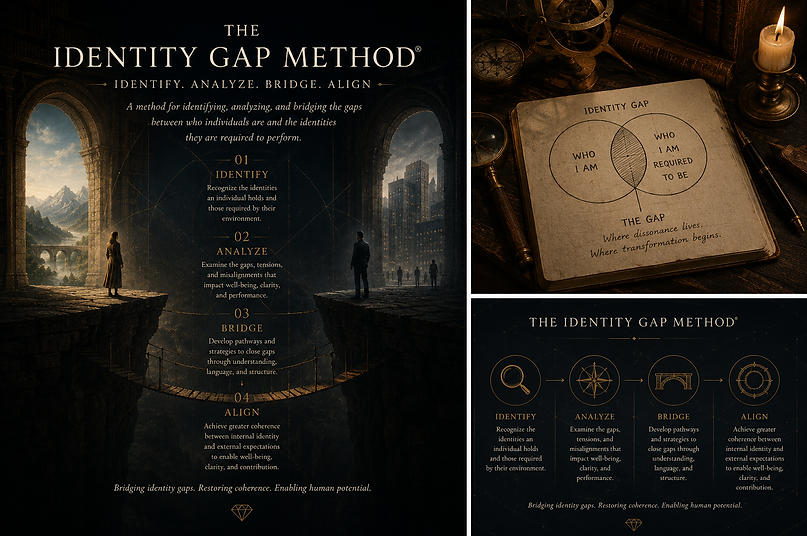
THE IDENTITY GAP METHOD™
Definition
The Identity Gap Method™ is a framework developed by Georgia Lee Arts for identifying and navigating the distance between an individual's current identity and the identity required to achieve a desired future state.
The method examines how identity influences perception, behavior, decision-making, relationships, leadership, and organizational outcomes.
Rather than focusing solely on skills, tactics, or external circumstances, The Identity Gap Method™ explores the ways identity can either facilitate or constrain personal, professional, and organizational transformation.
The framework recognizes that sustainable change often requires more than new information. It requires alignment between who a person is, who they believe themselves to be, and who they are becoming.
Origins
The Identity Gap Method™ emerged through years of observation and research into identity transition, occupational identity, human development, leadership, and organizational systems.
Its earliest foundations appeared in work exploring:
-
Identity Disruption
-
Burnout
-
Career Transition
-
Military Transition
-
Organizational Change
-
Meaning-Making
-
Narrative Identity
-
Language
Over time, these observations revealed a recurring pattern:
People often possessed the knowledge required for change but remained unable to achieve desired outcomes because their identity had not yet aligned with the future they were attempting to create.
The Identity Gap Method™ was developed to provide a framework for understanding and navigating that gap.
Publication Timeline
2006
A Mythopoetic Drama
An original dramatic work that would later influence the development of Elysian Dream® and subsequent publications.
Many of the themes later developed through Elysian Dream®, Dream Journey Breaking the Dream Barriers™ and The Identity Gap Method™ first appeared in embryonic form within this work.
2024
Dream Journey: Breaking the Dream Barriers™
Early exploration of identity, transformation, meaning, perception, narrative, and personal development. Origination of The Identity Gap Method.™
2025
The $2 Trillion Revenue Gap™
Expansion of identity concepts into organizational and economic systems.
Introduced the relationship between identity alignment, organizational performance, workforce outcomes, leadership effectiveness, and revenue generation. Expansion of The Identity Gap Method.™
2026
Occupational Psychosis Volume I: The Hidden Crisis Beneath Occupational Wellness
Expanded identity inquiry into occupational systems and institutional structures.
2026
Occupational Psychosis Volume II: Institutional Failure Modes
Extended analysis into structural patterns affecting organizational performance, authority systems, governance, and systemic outcomes.
2026
Occupational Psychosis Volume III: Authority, Ethics, and Governance (Institutional)
2026
Occupational Psychosis Volume IV: Stewardship (Institutional)
2026+ Occupational Wellness Institute™ Canon
The Identity Gap Method™ serves as one of several foundational concepts informing ongoing research into occupational wellness, organizational systems, stewardship, governance, and institutional development.
Relationship to Dream Journey, Breaking the Dream Barriers™
Dream Journey, Breaking the Dream Barriers™ represented an early exploration of identity transformation through narrative, symbolism, perception, meaning, and personal development.
Many of the questions that later informed The Identity Gap Method™ first appeared within that work.
Dream Journey, Breaking the Dream Barriers™ explored the human experience of becoming.
The Identity Gap Method™ later provided a structured framework for understanding that process.
Relationship to The $2 Trillion Revenue Gap™
The $2 Trillion Revenue Gap™ expanded the application of identity theory into organizational and economic systems.
Where The Identity Gap Method™ examines the distance between current and future identity, The $2 Trillion Revenue Gap™ examines the organizational and economic consequences of unresolved identity gaps.
The two concepts are related but distinct.
The Identity Gap Method™ focuses on identity transformation.
The $2 Trillion Revenue Gap™ focuses on the organizational outcomes that emerge when identity misalignment persists across individuals, teams, and systems.
Relationship to the Occupational Wellness Institute™
The Occupational Wellness Institute™ builds upon many of the concepts explored through The Identity Gap Method™ while extending inquiry into broader occupational and institutional systems.
Within OWI, identity is examined not only at the individual level but also through:
-
Occupational Identity
-
Role Identity
-
Authority Systems
-
Organizational Structures
-
Governance Systems
-
Institutional Narratives
-
Occupational Wellness
The Identity Gap Method™ remains one of the foundational concepts informing this body of work.
Foundational Concepts:
-
Identity
-
Occupational Identity
-
Identity Alignment
-
Identity Misalignment
-
Structure
-
Narrative
-
Meaning
-
Authority
-
Organizational Outcomes
-
Economic Outcomes
-
Occupational Wellness
-
Occupational Psychosis
-
Stewardship